Celebrating the New Moon: A Rosh Chodesh Anthology by Susan Berrin
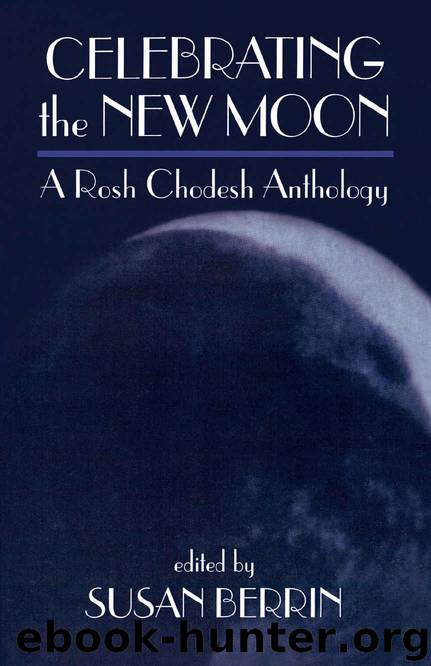
Author:Susan Berrin
Language: eng
Format: azw3
Publisher: Jason Aronson, Inc.
Published: 1998-05-01T04:00:00+00:00
Women Are Obligated to Pray
Women in traditional communities have in the past and continue to pray. Despite common misconceptions, women are not exempt from prayer. According to talmudic precedent, women are obligated to tefillah but are exempt from the recitation of the Sh’ma.1 There are many permutations and combinations of this basic mishnaic statement. The full impact is that women must pray at least once a day. The Shulhan Aruch further elaborates that despite the exemption, women should say the Sh’ma.2 However, they are exempt from public, time-constrained prayer. What are the consequences?
Exemption clearly does not mean exclusion. Women do attend services, especially on the Sabbath and High Holidays. But a distortion developed—women were not obligated, and hence not expected. Women were invisible publicly, and so many assumed that they did not have to pray or worse still that their prayers did not count. Moreover, they could not lead the services and were not counted in the official quorum, the minyan. Thus, the simple exemption shifted from a release to an exclusion, and even a banishment.
Ironically, the model of proper prayer is the silent prayer offered by Chana in the sanctuary.3 There are many instances in biblical narrative of women praying effectively, at times for personal reasons and in other instances for communal welfare. Leah is recorded as having offered the first prayer of thanksgiving to God4 and Miriam led the women in song and dance as a form of worship.5 Through her actions, Esther taught us about community fasting as a form of shared prayer, and Rachel weeps for the return of her exiled children. These women’s deeds prevail as our paradigms, even today.
Our concern today is with the location and format of women’s prayers. The need is for positive communal religious rituals in which women stand at the center. The challenge is to find ways to be more inclusive and to create opportunities for women’s spiritual expression in the context of our Jewish heritage.
Contemporary feminist scholarship has uncovered the history of women’s personal petitional prayers and regular attendance in synagogue. They prayed in a separate area, removed from the male-centered service. At their own pace, in their own words, and frequently following their own female leader, they uttered devotional prayers that reflected their own religious experiences. These tkhinot were communally sanctioned prayers that expressed private and public concerns, usually tendered by women in a public place (see Tracy G. Klirs’s chapter in this book, “Tkhines for Rosh Chodesh”). The firzogerin (women leaders) often led them as a cantor might today and explained or translated the weekly biblical portion as a rabbi does in sermonic description.
The talmudic tractate Soferim states that women were great synagogue goers and that it is a duty to translate the Torah portion for them.6 At some point in the medieval period, the rabbis encouraged translating the Hebrew prayers into Yiddish for the benefit of the women. Changes in structure and form were made to accommodate women praying in a group.7
Instead of relying completely on translations, our generation has learned and taught our daughters how to pray in Hebrew.
Download
This site does not store any files on its server. We only index and link to content provided by other sites. Please contact the content providers to delete copyright contents if any and email us, we'll remove relevant links or contents immediately.
The Power of Habit by Charles Duhigg(3116)
Man's Search for Meaning by Viktor E. Frankl(2658)
Mckeown, Greg - Essentialism: The Disciplined Pursuit of Less by Mckeown Greg(2413)
MOSES THE EGYPTIAN by Jan Assmann(2406)
Devil, The by Almond Philip C(2321)
The Complete Dead Sea Scrolls in English (7th Edition) (Penguin Classics) by Geza Vermes(2268)
Unbound by Arlene Stein(2261)
I Capture the Castle by Dodie Smith(2026)
Schindler's Ark by Thomas Keneally(1864)
The Invisible Wall by Harry Bernstein(1794)
The Gnostic Gospel of St. Thomas by Tau Malachi(1778)
The Bible Doesn't Say That by Dr. Joel M. Hoffman(1673)
The Secret Doctrine of the Kabbalah by Leonora Leet(1600)
Political Theology by Carl Schmitt(1567)
The Jewish State by Theodor Herzl(1525)
A History of the Jews by Max I. Dimont(1515)
The Dead Sea Scrolls Bible by Martin G. Abegg(1500)
The Book of Separation by Tova Mirvis(1477)
Oy!: The Ultimate Book of Jewish Jokes by David Minkoff(1359)
